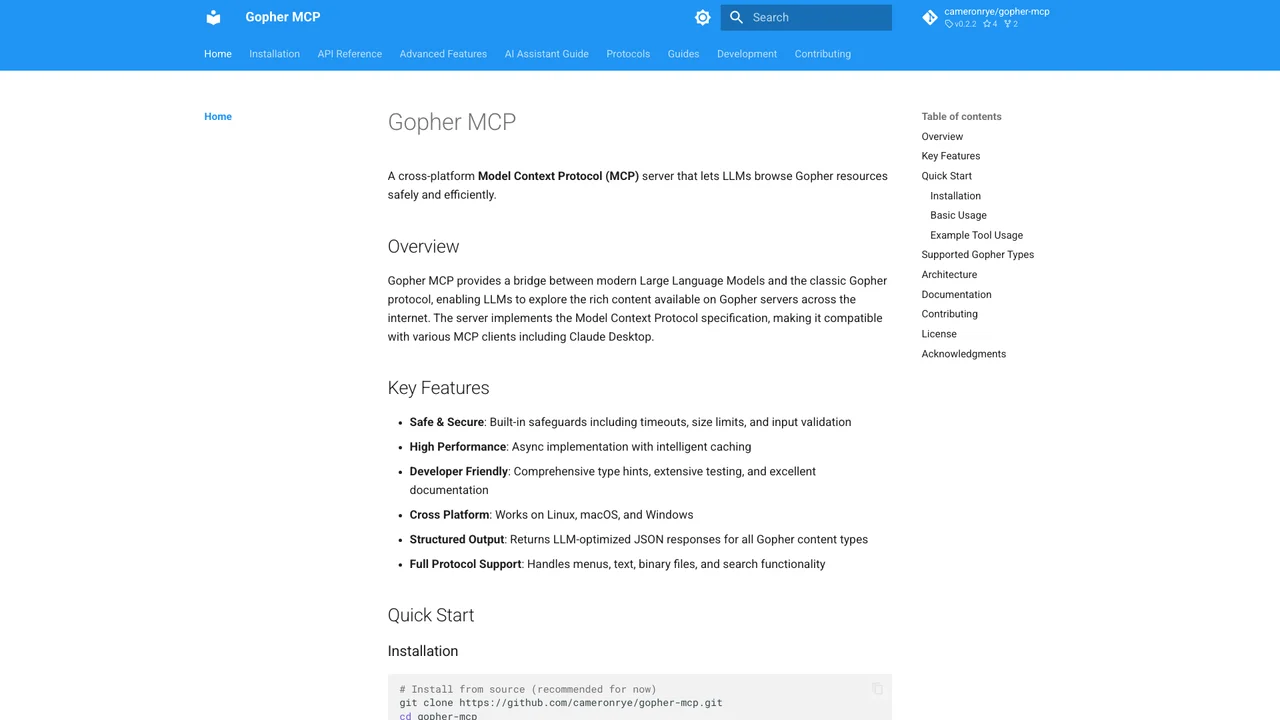
The small internet never went away. Enthusiasts still run thousands of Gopher and Gemini servers full of curated, text-first content (university archives, technical documentation, historical collections) that the modern web does not index. This MCP server hands that world to an AI assistant directly: request a menu, follow a selector, fetch a document, no HTML parsing required.
Gopher Client
Gives an AI client the Gopher and Gemini protocols — the “small internet”.
Key Features
- Dual Protocol Support: Access both Gopher and Gemini resources
- Cross-Platform: Works on Windows, macOS, and Linux
- Safe Browsing: Secure interaction with protocol resources
- MCP Integration: Standard Model Context Protocol interface
The Small Internet
Gopher and Gemini represent alternatives to the modern web:
- Gopher (1991): Hierarchical, menu-driven protocol predating HTTP
- Gemini (2019): Modern minimalist protocol with TLS encryption
Both protocols focus on text content and simple navigation, offering a distraction-free reading experience that many enthusiasts prefer to the modern web.
What was hard
The key design decision was treating Gopher and Gemini as one protocol family behind a shared handler abstraction: each protocol implements the same fetch-and-describe interface, so supporting a new protocol means writing one handler rather than touching the MCP layer. Gopher’s type system needed translation too. It predates MIME, marking each item with a single character (0 for text, 1 for menus, I for images), so the server maps those onto MIME types before content reaches the model. Safety came down to refusing to trust remote servers: response size caps, connection timeouts, and content type validation keep a misbehaving host on a 35-year-old protocol from breaking the assistant’s session.
Was this helpful?
Want to learn more?
Ask can answer questions about this project's implementation, technologies, and more.