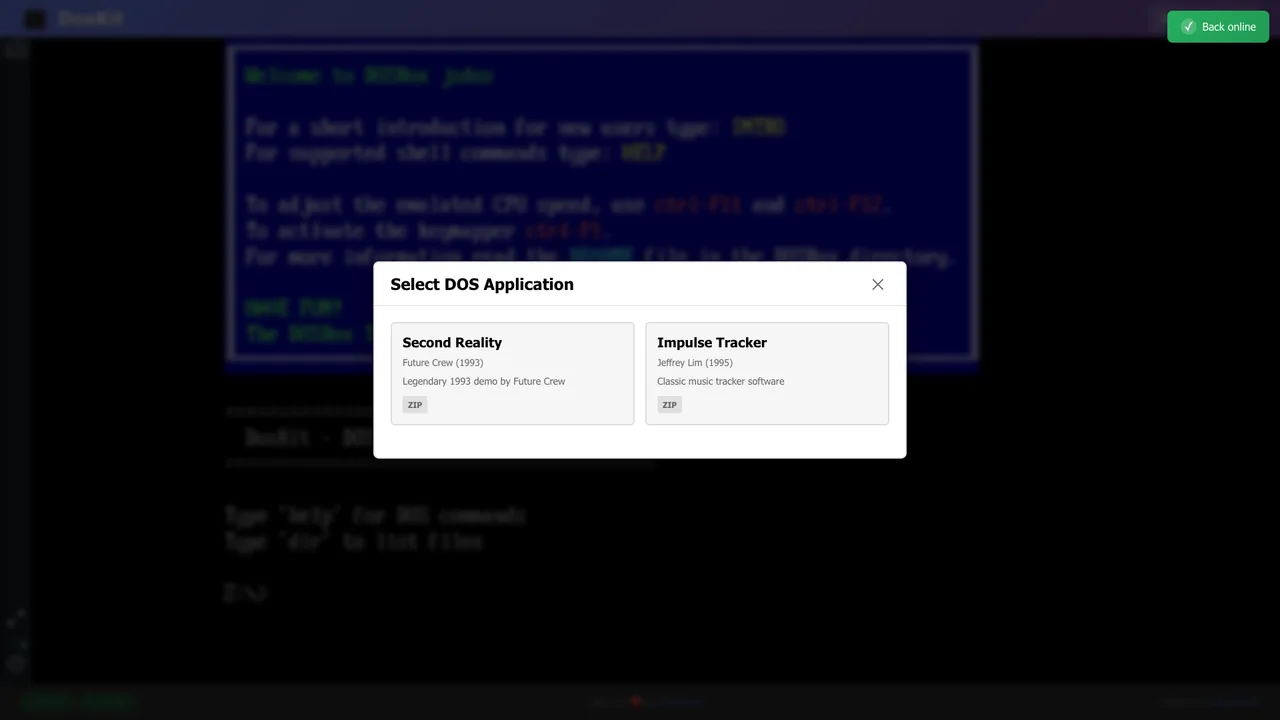
DosKit brings classic DOS software to modern browsers through WebAssembly emulation. Nothing to install and nothing to configure: you click, and it runs.
Key Features
- Instant Access: One-click access to DOS software
- Browser-Based: Runs entirely in the browser via WebAssembly
- Curated Library: Classic demos, games, and applications
- Mobile Friendly: Touch controls for mobile devices
Technical Implementation
DosKit uses js-dos, a WebAssembly port of DOSBox, to run x86 DOS binaries directly in the browser:
const dos = await Dos(canvas, {
  wdosboxUrl: '/wdosbox.js',
  autoStart: true
});

await dos.fs.extract('/software.zip');
await dos.main(['-c', 'SOFTWARE.EXE']);
The emulator handles CPU emulation, memory management, and audio/video output, providing an authentic DOS experience without any native installation.
Why this was worth building
A lot of classic software preservation efforts are technically impressive but still inaccessible to most people. If someone has to learn emulator configuration before they can try a demo, the preservation effort has not fully crossed into public accessibility. DosKit was built to reduce that gap to a single click.
Product and engineering tradeoffs
Running old software in the browser sounds simple until you account for startup time, asset packaging, keyboard handling, audio behavior, and mobile input. The experience had to feel immediate enough for casual exploration while still preserving the character of the original software.
That led to a few practical decisions:
- keep the launch path short so users reach the software quickly
- package software and emulator configuration together instead of expecting manual setup
- support touch controls for devices that do not have a physical keyboard
- curate the library so the first-run experience highlights software that is historically interesting and technically representative
Product framing
The hard part of DosKit was product framing, not emulation. WebAssembly turns a fiddly setup process into a plain web page, and a curated library keeps a niche corner of computing approachable.
Outcome
What you get is a preservation product that still feels current: fast launch, zero installation, cross-device support, and a clear reason the software matters. The emulator core, the software, and its configuration all ship together as one web page that loads in under three seconds.
Was this helpful?
Want to learn more?
Ask can answer questions about this project's implementation, technologies, and more.