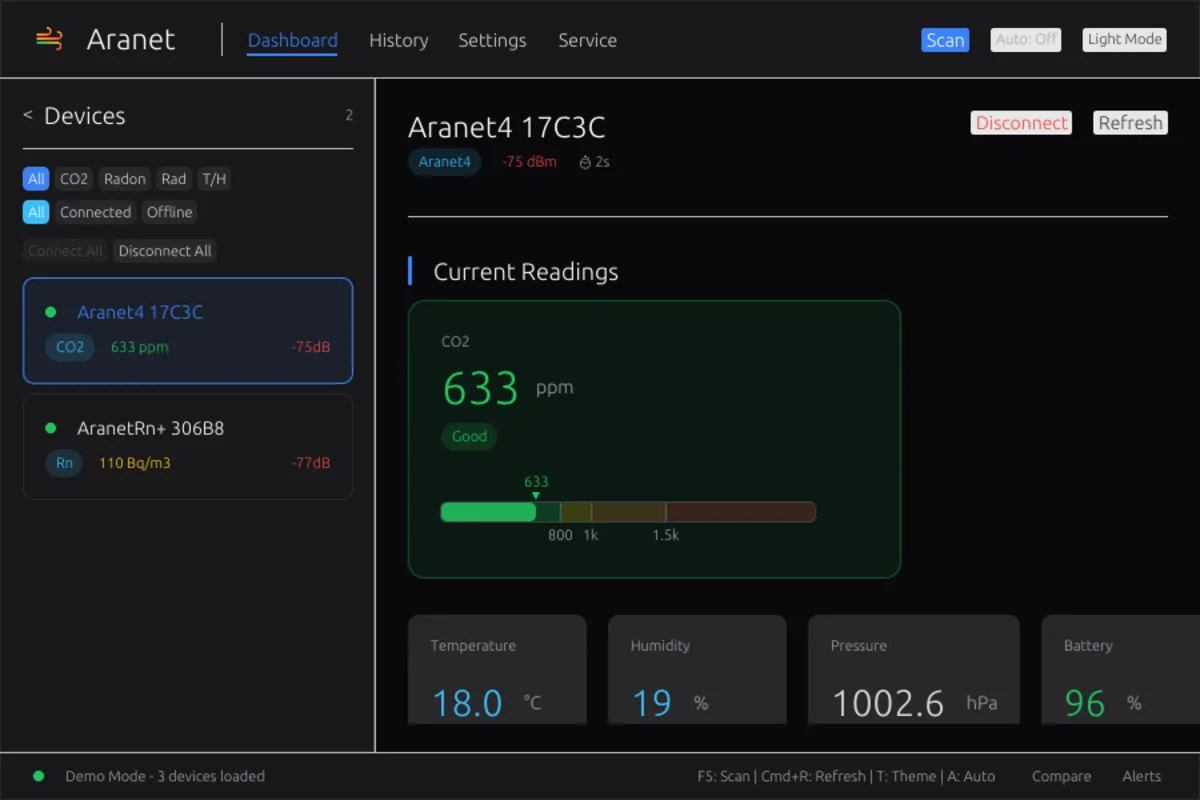
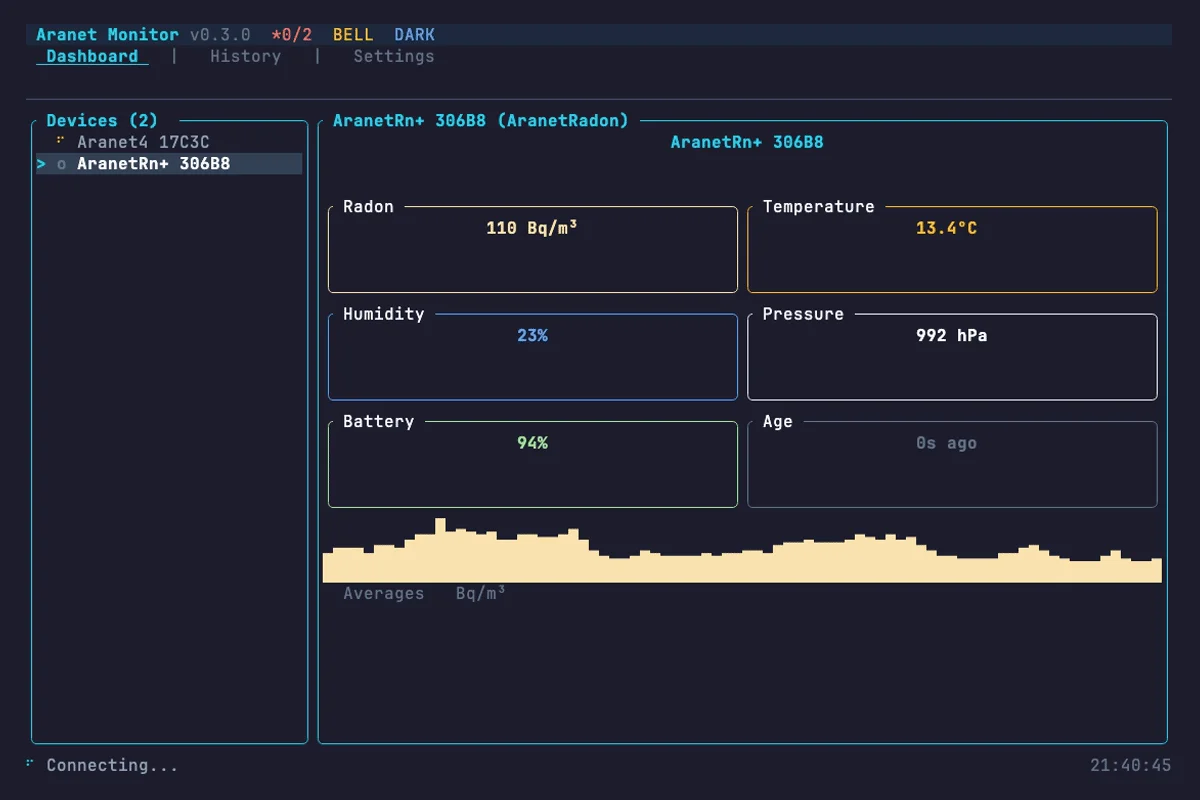
Aranet is a comprehensive Rust implementation for connecting to Aranet environmental sensors via Bluetooth Low Energy. The workspace provides everything from low-level BLE communication to polished user interfaces and production monitoring integrations.
Key Features
- Multi-sensor support: CO2, temperature, pressure, humidity, radon, and radiation readings from four Aranet device families
- Historical data download: Resumable checkpoints, date filters, and incremental sync with local SQLite storage
- Passive monitoring: Read BLE advertisements without establishing a device connection
- Terminal dashboard: Sparkline charts, CO2/radon threshold alerts, vim keybindings, and CSV export via ratatui
- Desktop GUI: Multi-panel egui interface with alert system and system tray
- Background service: REST API with WebSocket streaming for real-time data
- Observability: Prometheus metrics endpoint with pre-built Grafana dashboard template
- IoT integration: MQTT publisher with Home Assistant auto-discovery, InfluxDB export, webhook notifications
Why Rust
Environmental monitoring runs continuously on modest hardware. Rust’s zero-cost abstractions and memory safety make it the right choice for a long-running BLE daemon that needs to be reliable without consuming resources. The workspace structure keeps each concern in its own crate while sharing the core protocol implementation across every interface.
Architecture decisions
The seven-crate workspace follows a clear layering:
- aranet-types provides platform-agnostic shared types
- aranet-core handles all BLE communication and protocol parsing
- aranet-store manages local SQLite persistence with deduplication and incremental sync
- aranet-service adds the daemon layer with REST, WebSocket, MQTT, Prometheus, and webhook integrations
- aranet-cli, aranet-tui, and aranet-gui are thin interfaces over the core and store crates
This separation means adding a new integration or interface requires no changes to the sensor communication layer.
Distribution
The project ships via multiple channels to minimize friction:
- Homebrew:
brew tap cameronrye/aranet && brew install aranet - crates.io:
cargo install aranet-cli - GitHub Releases: Shell and PowerShell installers, macOS DMG bundles
- Docker Compose: Pre-configured stack with Prometheus and Grafana
Outcome
Aranet proves that embedded sensor tooling does not need to be locked behind mobile apps or cloud services. By building from BLE packets up through storage, APIs, and dashboards in a single Rust workspace, the project gives users full control over their environmental data with the reliability and performance characteristics that monitoring infrastructure demands.
Was this helpful?
Want to learn more?
Ask can answer questions about this project's implementation, technologies, and more.