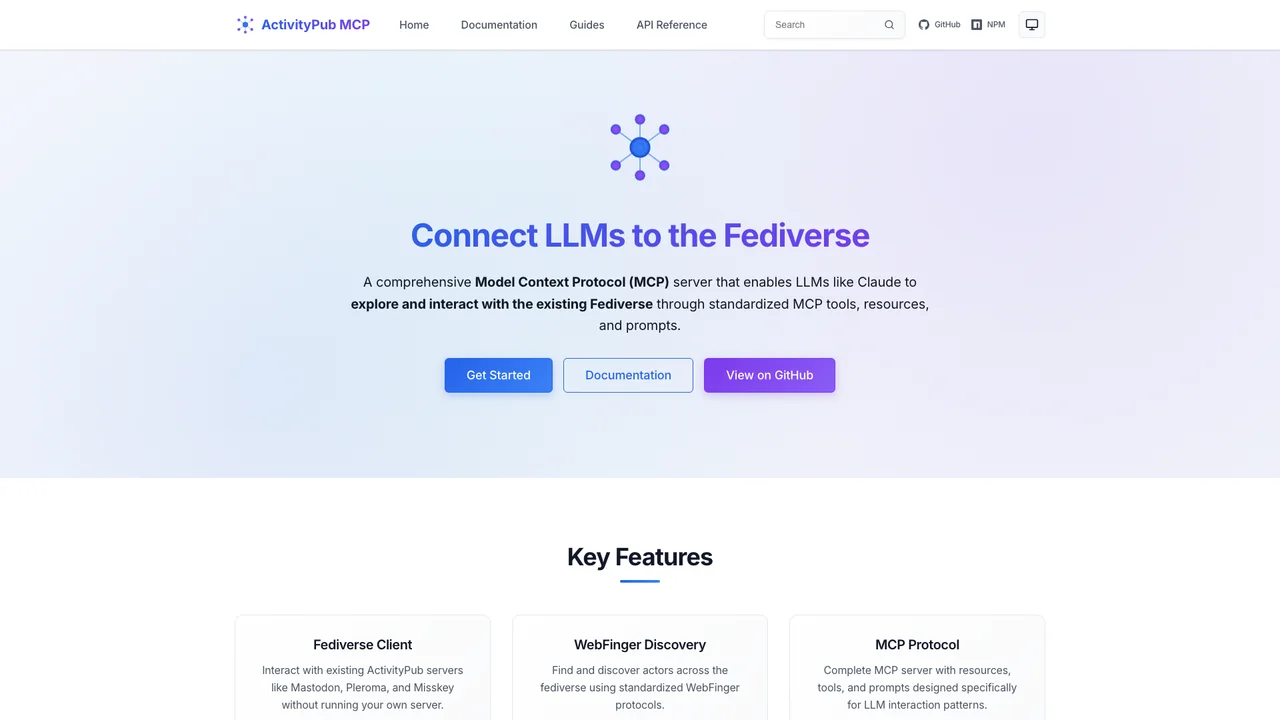
The ActivityPub MCP Server connects AI assistants to the Fediverse, the decentralized social network that includes Mastodon, Pixelfed, and thousands of other instances. It’s built on Fedify, which handles the ActivityPub protocol.
MCP Tool Explorer
{
  "tool": "webfinger_lookup",
  "account": "@user@mastodon.social"
}Discover a user via WebFinger lookup
This is a simulated demo. The real MCP server answers requests from AI assistants like Claude.
Key Features
- Fediverse Access: Connect to any ActivityPub-compatible server
- WebFinger Support: Discover users across federated instances
- MCP Tools & Prompts: Standardized interface for AI interaction
- Fedify Integration: Built on the Fedify framework for reliability
The engineering challenge
ActivityPub is valuable precisely because it is decentralized, but that decentralization creates the core challenge for AI integration. There is no single canonical API surface, implementations vary across servers, and even simple tasks like resolving an account handle require protocol-aware discovery through WebFinger.
The goal of this server was to hide the friction without flattening away the protocol. An assistant should be able to explore the Fediverse as a network of actors, inboxes, outboxes, and objects, not as a brittle collection of server-specific REST calls.
Why Fedify was the right foundation
I built the server on Fedify because correctness mattered more than speed of a one-off integration. Fedify gave me a durable protocol layer for:
- WebFinger resolution
- ActivityPub actor and object handling
- cross-instance compatibility
- a cleaner abstraction over the differences between Fediverse implementations
That choice let the MCP layer focus on tool design and response shaping instead of re-implementing protocol details from scratch.
Design tradeoffs
There is a tension between exposing a rich social graph and keeping tool calls understandable for an LLM. I addressed that by making the tools explicit and composable: discover an account, fetch the actor, inspect the outbox, then traverse outward. That produces a better agent experience than trying to hide everything behind one overloaded endpoint.
The other tradeoff was resiliency. In a federated network, partial failure is normal. Different instances may be slow, unavailable, or slightly inconsistent. The server therefore had to prefer graceful degradation and clear error reporting over pretending every node behaves the same way.
Outcome
The hardest constraint turned out to be partial failure. In a federated network some instances are always slow, unreachable, or slightly nonstandard, so the server treats graceful degradation and clear error reporting as core features rather than edge cases. An assistant exploring the Fediverse gets an honest answer about a dead instance instead of a hung request.
Was this helpful?
Want to learn more?
Ask can answer questions about this project's implementation, technologies, and more.